

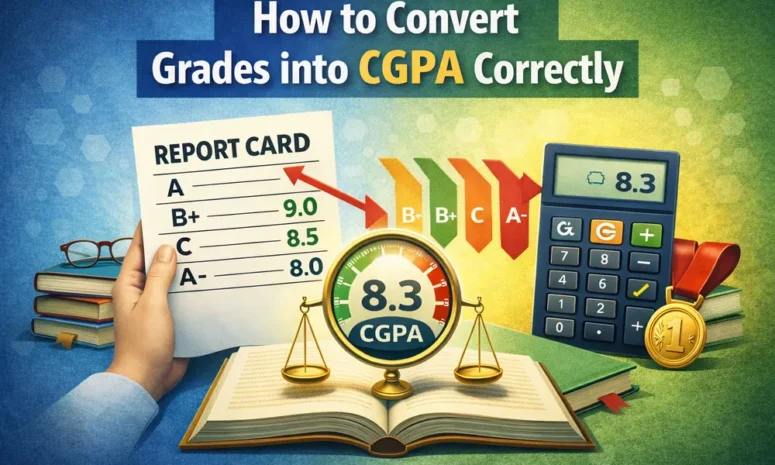
Students often assume that converting grades into CGPA is as simple as averaging letters or percentages. The confusion usually begins when institutions use different grading scales, credit systems, or conversion formulas. A small miscalculation can lead to incorrect academic reporting, scholarship eligibility issues, or even problems during international applications. What appears to be a basic arithmetic task often turns into a stressful guessing exercise.
The reality is that CGPA calculation follows structured logic based on grade points and credit weights. When done correctly, it provides a precise reflection of academic performance across semesters. When done incorrectly, it distorts performance evaluation and may misrepresent academic standing. Understanding how grade points translate into CGPA ensures transparency, accuracy, and confidence when submitting transcripts or academic profiles.
Understanding the Foundation of CGPA Calculation
CGPA, or Cumulative Grade Point Average, represents the weighted average of grade points earned across all subjects. Each grade corresponds to a specific numerical value known as a grade point. However, subjects often carry different credit values, which means not all courses influence CGPA equally. Higher credit courses contribute more heavily to the final calculation.
The key principle is weighted averaging. Instead of simply averaging grade points, each grade point must be multiplied by its course credit. The sum of these weighted scores is then divided by the total number of credits attempted. This ensures fairness, particularly in professional programs where core subjects carry more academic weight.
Basic Formula Explained in Simple Terms
The formula for CGPA is: Total of (Grade Point × Credit) divided by Total Credits. This means you first convert each grade into its numeric equivalent, multiply it by the credit of that subject, and then add all those results together.
Once you sum the weighted values, divide the total by the overall credits taken. The result is your CGPA. The logic remains consistent across universities, though grade scales may differ slightly.
Converting Letter Grades into CGPA: A Practical Example
Consider a semester with five subjects. Assume the grade scale is: A = 10, B = 8, C = 6, D = 4. Now imagine the student earns: A in a 4-credit subject, B in a 3-credit subject, A in a 3-credit subject, C in a 2-credit subject, and B in a 2-credit subject.
First, multiply grade points by credits. For the first subject: 10 × 4 = 40. Second subject: 8 × 3 = 24. Third subject: 10 × 3 = 30. Fourth subject: 6 × 2 = 12. Fifth subject: 8 × 2 = 16. The total weighted score becomes 122. The total credits equal 14.
Now divide 122 by 14. The CGPA becomes 8.71. Notice how the 4-credit subject significantly influenced the final result. If that subject had been graded lower, the CGPA would drop more sharply.
Converting Percentage Marks into CGPA
Some institutions use percentage-based evaluation and later convert it into CGPA using standardized conversion formulas. A common approach in certain systems is dividing percentage by 9.5, though this method applies only when officially prescribed by the academic board.
For example, if a student scores 76% overall, dividing 76 by 9.5 gives approximately 8.0 CGPA. However, this shortcut works only when explicitly defined by the governing authority. Blindly applying it without verification can lead to incorrect academic representation.
Numeric Scenario: Weighted Percentage Conversion
Suppose a student scores 85% in a 4-credit subject and 70% in a 2-credit subject. Instead of averaging percentages directly, multiply 85 by 4 (340) and 70 by 2 (140). The total becomes 480. Divide this by total credits (6), giving 80% overall weighted percentage.
If the institution converts percentage to CGPA using a defined rule, apply that rule to 80%. This ensures that higher credit subjects influence the final value appropriately.
Short-Term Accuracy vs Long-Term Academic Impact
An incorrect CGPA conversion might seem minor initially, but it can affect scholarship eligibility, postgraduate admissions, and international credential evaluations. Universities abroad often scrutinize academic transcripts carefully. Even decimal-level differences may impact merit-based shortlisting.
In the short term, rounding errors or incorrect formulas may go unnoticed. In the long term, however, cumulative academic records shape professional opportunities. Just as financial compounding increases wealth over time, academic averages accumulate impact across semesters.
Precision also influences confidence. Students who clearly understand how their CGPA is derived are better prepared to evaluate improvement strategies. Misunderstanding calculation methods can create unnecessary anxiety or misplaced academic pressure.
Where Most Students Go Wrong
One common mistake is averaging grade points without considering credit weights. This produces inaccurate results, especially when course credits vary significantly. A low grade in a high-credit subject affects CGPA more than a low grade in a minor elective.
Another frequent error is using unofficial percentage-to-CGPA formulas found online. Institutions differ in conversion standards, and applying the wrong divisor can distort academic standing.
Students also tend to round intermediate values too early. Rounding grade-point multiplications before final calculation can slightly alter the final CGPA. Proper practice involves rounding only the final result as per institutional rules.
Finally, some learners ignore repeated subjects. If a course is retaken, universities may replace the earlier grade or average both attempts depending on policy. Not understanding this rule leads to misreporting cumulative averages.
A Structured Approach to Accurate CGPA Conversion
Start by confirming your institution’s official grade scale and credit system. Without clarity on these parameters, any calculation risks being flawed. Academic handbooks usually define grade-point mappings and rounding conventions.
Next, list all subjects with corresponding credits and grade points in a structured format. Multiply each grade point by its credit before summing totals. Avoid shortcuts unless formally authorized by your academic board.
If your transcript uses percentages, verify the exact conversion formula prescribed by your university. Never assume uniformity across institutions. When in doubt, consult academic authorities rather than relying on generalized online formulas.
Finally, cross-check calculations manually at least once. Even simple arithmetic errors can distort outcomes. A disciplined step-by-step approach ensures your CGPA reflects true academic performance.
Frequently Asked Questions
Is CGPA simply the average of all grade points?
No. CGPA is a weighted average that considers course credits. Simply averaging grade points without accounting for credits produces incorrect results.
Can I use a universal formula to convert percentage to CGPA?
No. Percentage-to-CGPA conversion depends on institutional guidelines. Always follow the official formula defined by your academic board.
Do higher credit subjects affect CGPA more?
Yes. Subjects with higher credits carry more weight in CGPA calculations because they represent greater academic workload and importance.
Should I round off each subject’s grade point?
It is better to round only the final CGPA unless your institution specifies otherwise. Early rounding can slightly distort results.
What happens if I repeat a subject?
Policies vary. Some institutions replace the old grade, while others average both attempts. Always confirm the rule before recalculating CGPA.
Is CGPA important for job applications?
Yes, particularly for entry-level roles and higher education admissions. Accurate reporting reflects academic integrity and transparency.